
There are phases in professional life when time stops behaving like a calendar and starts behaving like a stretch of intensity. Projects overlap, responsibilities stack up, and days begin to feel less like individual units and more like a continuous flow of execution. In those periods, especially in fast-developing zones like Bommasandra in Bangalore, professionals don’t really think in terms of “short stay” or “long stay”—they think in terms of “how long this phase will last.”
And that changes everything about where they live temporarily.
During such phases, accommodation is no longer about switching environments frequently. It becomes about finding a stable base that can quietly support a demanding schedule without adding complexity to it. The focus is not on lifestyle variation—it is on operational ease.
In practice, the day starts early and often ends late, but not in a chaotic way. It follows a predictable intensity. Travel to industrial sites, meetings with teams, review cycles, vendor discussions, and planning sessions all blend into one continuous loop of responsibility. By the time the day winds down, the need is not for stimulation, but for stability.
This is where the importance of a steady living environment becomes clear.
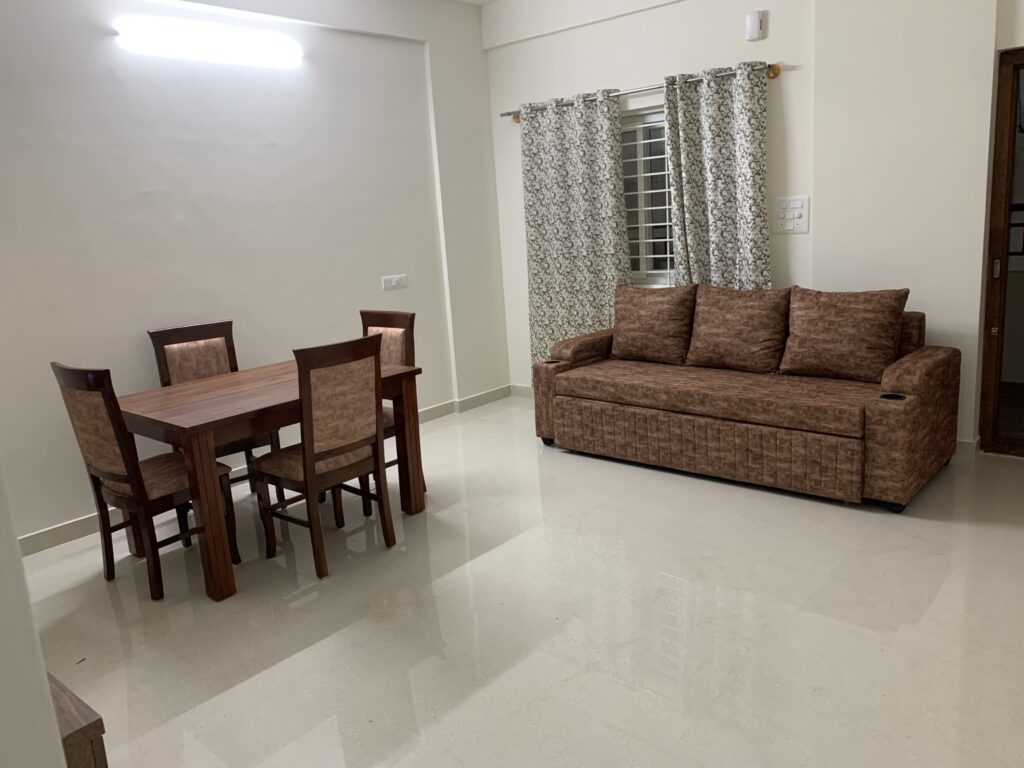
A place like Sagar Niwas doesn’t compete with the rhythm of work—it simply stays out of its way. There is no need to adjust to unfamiliar systems every day, no friction in handling basic routines, and no mental overhead attached to living logistics. That absence of friction quietly preserves energy for the work itself.
And over time, something subtle happens.
People stop “managing stay” and start “using time better.” Even small windows of time begin to feel usable—an hour after returning, a short break between calls, or a quiet morning before stepping out. Instead of being consumed by adjustment, that time becomes available for recovery, reflection, or preparation.
For professionals working on long-duration assignments—whether in engineering, consulting, operations, or field execution—this shift is often more valuable than any visible feature. It doesn’t show up immediately, but it compounds daily.
The environment becomes part of the workflow without demanding attention. That is what makes it effective during high-pressure phases. It doesn’t interrupt momentum. It supports it quietly in the background.
And when the project eventually ends or transitions into a new phase, what people often remember is not the intensity alone, but the fact that they were able to maintain it without unnecessary disruption from their living situation.
Because in the end, when work becomes a season rather than a schedule, what matters most is not where you stay—but how smoothly that place lets you continue.
🌐 www.sagarniwas.com
📞 +91 9972769456