
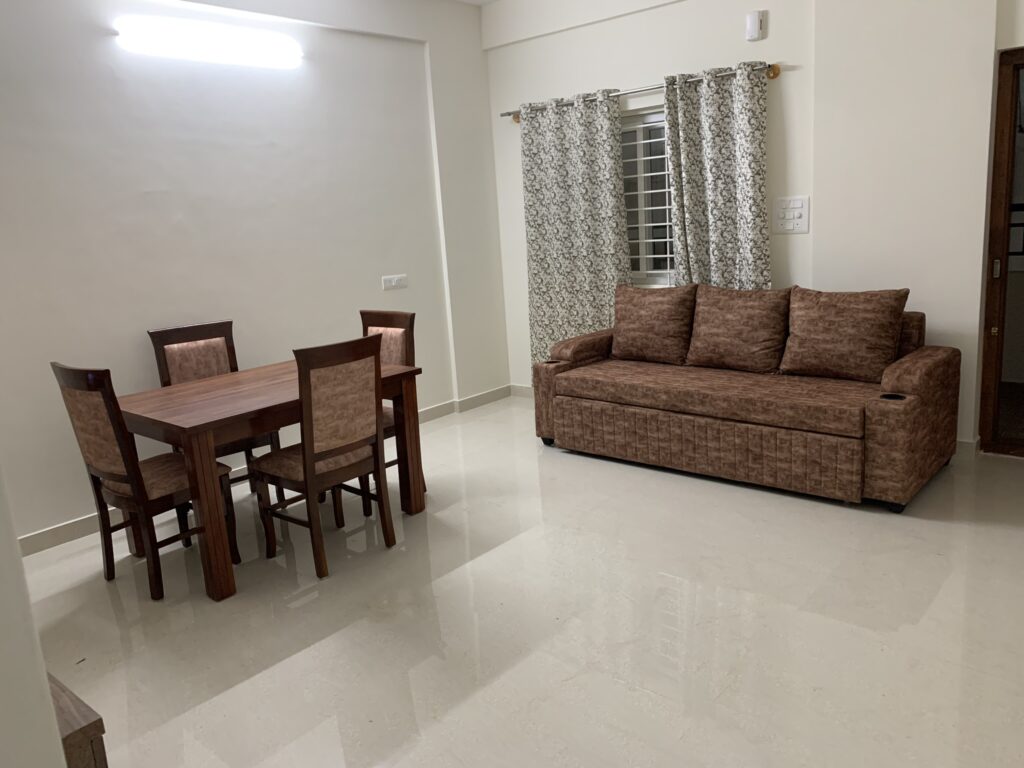
When work becomes continuous rather than compartmentalized, the idea of “going back home” changes. For many professionals operating in and around Bommasandra in Bangalore, the day does not really end at a fixed hour. It phases out gradually—meetings turn into follow-ups, site visits turn into reports, and decisions made during the day often need reflection at night.
In that kind of flow, the value of a stay is not measured by how much it offers for leisure, but by how little it interferes with thought.
Over time, people begin to notice a subtle difference in how they function when the space around them stays consistent. There is no mental reset required every day. No adjustment to unfamiliar surroundings. No time lost figuring out logistics that are unrelated to work. The energy that would normally go into managing “where I am staying” quietly gets redirected into “what I am working on.”
That shift may seem small, but in practice, it changes productivity in a very real way.
Some professionals use this stability to extend their focus beyond working hours—not by working more, but by thinking better. Reviewing project notes without pressure. Re-evaluating decisions taken during the day. Planning the next set of actions without interruption. The environment doesn’t accelerate work; it simply removes friction from it.
There is also a quieter benefit that becomes more noticeable during longer stays. Routine stops feeling fragmented. Sleep, work, meals, and planning start to form a natural cycle instead of a disrupted one. This consistency is what allows people handling high-responsibility roles to avoid burnout even when workloads remain heavy.
In spaces like Sagar Niwas, this experience is not manufactured. It comes from predictability. When basic living needs don’t require repeated effort, the mind is free to stay in its primary role—whether that is managing operations, handling clients, or executing technical work.
And because the location sits close to industrial and business activity zones, transition between “work mode” and “rest mode” doesn’t involve long recovery time. The shift is shorter, smoother, and less mentally draining.
Over weeks, this starts to matter more than it initially appears. Work quality improves not because conditions become perfect, but because interruptions reduce. Decision-making becomes clearer because the mind isn’t constantly switching contexts. Even simple tasks feel easier because the background structure remains stable.
This is often the real reason professionals prefer such stays during project-heavy phases. Not comfort in the traditional sense—but continuity. A place that doesn’t reset their rhythm every day, but instead allows it to continue uninterrupted.
And in a city that rarely slows down, that continuity becomes a quiet kind of advantage.
🌐 www.sagarniwas.com
📞 +91 9972769456